

如何将训练好的机器学习模型嵌入到业务系统?
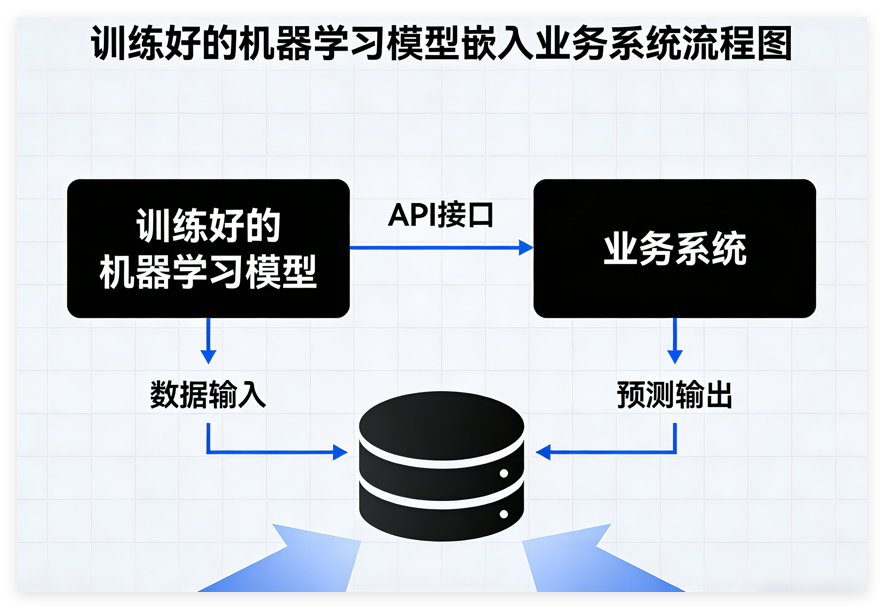
将训练好的机器学习模型嵌入到业务应用系统中,有多种方法可以实现。让我为您详细介绍几种常见的部署方式:
首先保存模型,代码如下:
import joblib
joblib.dump(model, 'pressure_ulcer_svm_model.pkl')
joblib.dump(scaler, 'pressure_ulcer_scaler.pkl')
print("
模型已保存为 'pressure_ulcer_svm_model.pkl'")
print("标准化器已保存为 'pressure_ulcer_scaler.pkl'")
1. 模型文件加载与预测API
您已经使用joblib保存了模型,可以创建一个预测服务:
import joblib
import pandas as pd
import numpy as np

class PressureUlcerPredictor:
    def __init__(self, model_path='pressure_ulcer_svm_model.pkl',
                 scaler_path='pressure_ulcer_scaler.pkl'):
        self.model = joblib.load(model_path)
        self.scaler = joblib.load(scaler_path)

    def predict_single(self, patient_data):
        """
        预测单个患者的压疮风险
        patient_data: dict, 包含患者各项生理指标
        """
        # 将输入数据转换为DataFrame
        df = pd.DataFrame([patient_data])

        # 数据预处理(需要与训练时保持一致)
        df_scaled = self.scaler.transform(df)

        # 进行预测
        prediction = self.model.predict(df_scaled)[0]

        # 获取预测概率
        probabilities = self.model.predict_proba(df_scaled)[0]

        return {
            'prediction': int(prediction),
            'probabilities': probabilities.tolist(),
            'risk_level': self._interpret_risk(prediction)
        }

    def _interpret_risk(self, prediction):
        # 根据实际标签定义风险等级
        risk_levels = {0: '低风险', 1: '中风险', 2: '高风险'}
        return risk_levels.get(prediction, '未知风险')
2. REST API服务
创建一个Web API供业务系统调用:
from flask import Flask, request, jsonify
import joblib

app = Flask(__name__)
predictor = PressureUlcerPredictor()

@app.route('/predict', methods=['POST'])
def predict_pressure_ulcer():
    try:
        patient_data = request.json
        result = predictor.predict_single(patient_data)
        return jsonify(result)
    except Exception as e:
        return jsonify({'error': str(e)}), 400

if __name__ == '__main__':
    app.run(host='0.0.0.0', port=5000)
3. 微服务架构集成
如果您有微服务架构,可以将模型封装为独立的微服务:
# model_service.py
import grpc
from concurrent import futures
import model_pb2
import model_pb2_grpc

class ModelService(model_pb2_grpc.ModelServiceServicer):
    def Predict(self, request, context):
        # 处理预测请求
        patient_data = {
            '性别': request.gender,
            '年龄': request.age,
            '白细胞': request.wbc,
            # ... 其他特征
        }

        result = predictor.predict_single(patient_data)

        return model_pb2.PredictionResponse(
            risk_level=result['risk_level'],
            confidence=max(result['probabilities'])
        )

server = grpc.server(futures.ThreadPoolExecutor(max_workers=10))
model_pb2_grpc.add_ModelServiceServicer_to_server(ModelService(), server)
server.add_insecure_port('[::]:50051')
server.start()
4. 数据库集成
可以在数据库层面集成预测功能:
-- 创建存储过程来调用模型预测
CREATE PROCEDURE PredictPressureUlcer(
    @gender INT,
    @age FLOAT,
    @wbc FLOAT,
    @result NVARCHAR(50) OUTPUT
)
AS
BEGIN
    -- 调用Python脚本或外部模型服务
    EXEC sp_execute_external_script
    @language = N'Python',
    @script = N'
import pickle
import numpy as np

# 加载模型和预测逻辑
with open("pressure_ulcer_svm_model.pkl", "rb") as f:
    model = pickle.load(f)

input_data = np.array([[gender, age, wbc]])  # 根据实际特征顺序调整
prediction = model.predict(input_data)[0]
result = str(prediction)
',
    @params = N'@gender float, @age float, @wbc float, @result nvarchar(50) OUTPUT',
    @gender = @gender,
    @age = @age,
    @wbc = @wbc,
    @result = @result OUTPUT;
END
5. 实时预测集成示例
为业务系统提供实时预测接口:
# business_integration.py
import requests
import json

class BusinessIntegration:
    def __init__(self, api_url='http://localhost:5000/predict'):
        self.api_url = api_url

    def predict_patient_risk(self, patient_info):
        """
        为业务系统提供患者风险预测接口
        """
        response = requests.post(
            self.api_url,
            json=patient_info,
            headers={'Content-Type': 'application/json'}
        )

        if response.status_code == 200:
            return response.json()
        else:
            raise Exception(f"Prediction failed: {response.text}")

    def batch_predict(self, patients_list):
        """
        批量预测多个患者的风险
        """
        results = []
        for patient in patients_list:
            try:
                result = self.predict_patient_risk(patient)
                results.append(result)
            except Exception as e:
                results.append({'error': str(e)})

        return results

# 业务系统中使用
integration = BusinessIntegration()

# 在患者录入或更新时自动触发风险评估
def on_patient_update(patient_record):
    risk_assessment = integration.predict_patient_risk({
        '性别': patient_record['gender'],
        '年龄': patient_record['age'],
        '白细胞': patient_record['wbc'],
        # ... 其他必需的特征
    })

    # 根据风险等级触发相应业务逻辑
    if risk_assessment['risk_level'] == '高风险':
        trigger_alert(patient_record['patient_id'])
        schedule_frequent_monitoring(patient_record['patient_id'])
6. 监控和更新机制
为了确保模型在生产环境中持续有效:
# model_monitoring.py
import datetime
from collections import defaultdict

class ModelMonitor:
    def __init__(self):
        self.prediction_log = []
        self.performance_metrics = defaultdict(list)

    def log_prediction(self, input_data, prediction, actual_result=None):
        log_entry = {
            'timestamp': datetime.datetime.now(),
            'input': input_data,
            'prediction': prediction,
            'actual': actual_result
        }
        self.prediction_log.append(log_entry)

    def calculate_drift(self, new_data_batch):
        # 检测数据漂移
        pass

    def trigger_retraining(self):
        # 当性能下降时触发重新训练
        pass
实施建议:
- API优先:建议首先创建REST API,这样业务系统可以通过HTTP请求调用模型
- 异步处理:对于批量预测,使用异步队列处理
- 缓存机制:对频繁查询的结果进行缓存
- 监控告警:建立模型性能监控和异常告警机制
- 版本管理:实现模型版本管理,支持灰度发布
这样,训练好的机器学习预测模型就可以无缝集成到业务应用系统中。